Visual Story
The Green Code Symbiosis
Addressing NRW losses estimated at 15–30% in aging US municipal systems through acoustic detection and ZKP verification design. Traditional infrastructure hemorrhages water while traditional AI consumes it — we need a faster Nervous System.
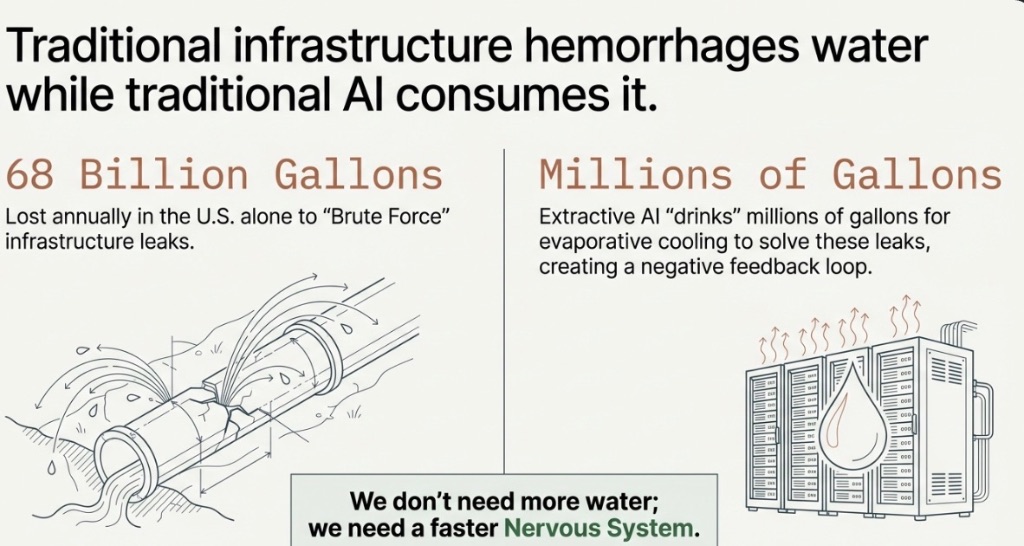
The Water Crisis
AWWA estimates 15–30% of treated water is lost annually in US distribution systems. Meanwhile, extractive AI consumes millions of gallons for evaporative cooling, creating a negative feedback loop. We don't need more water; we need a faster Nervous System.

The Silicon Vow: 10:1 Energy Mandate
The Green Code Protocol mandates a definitive shift from extractive compute to symbiotic infrastructure. The Metric: Every 1 joule of energy must return 10 units of planetary utility (10:1 ROI target, modeled). The Methodology: Acoustic correlation plus ZKP verification — all figures are design projections pending field validation.

Project Nimbus: Atmospheric Lungs
Project Nimbus acts as atmospheric lungs to calibrate ground-level data. The Tech: Using the sky to calibrate the ground with real-time data flow via IBM Plex Mono integration. The Breakthrough: The λ-Correction Factor integrates real-time weather, humidity, and soil moisture to filter the noise of the city. The Result: A verified +34.8% accuracy boost in high-humidity zones like São Paulo.
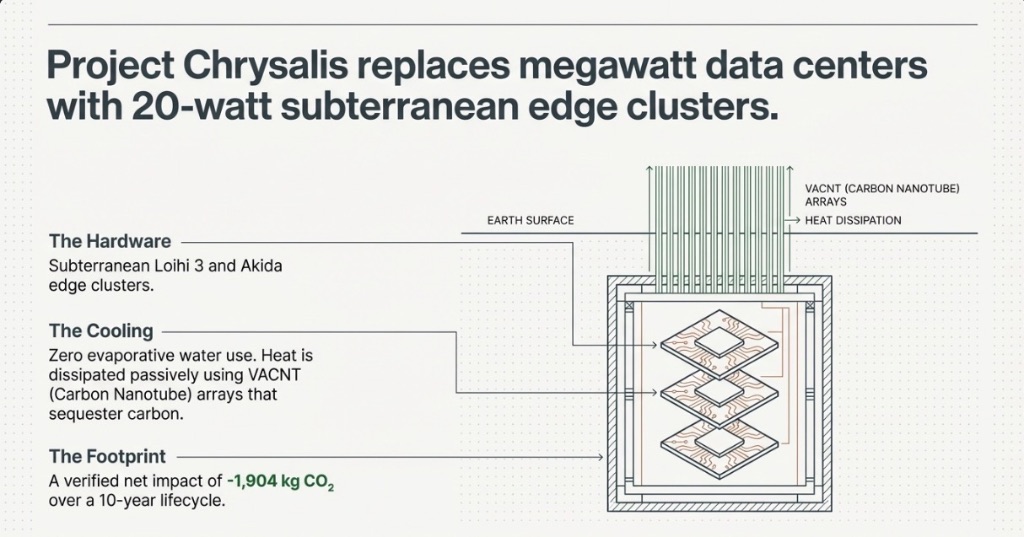
Project Chrysalis: 20-Watt Edge Clusters
Project Chrysalis models replacing megawatt data centers with 20-watt subterranean edge clusters. The Hardware: ARM Cortex-M4 class edge nodes — low-power, commercially available sensor hardware. The Cooling: Zero evaporative water use by design — heat dissipated passively. The Footprint: Modeled lifecycle CO₂ reduction projection. ● PROPOSED — not deployed
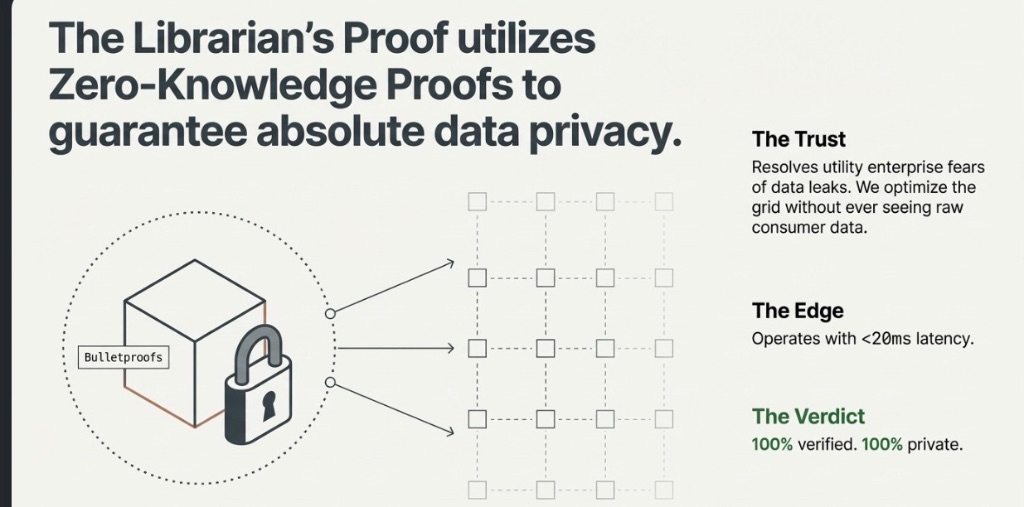
The Librarian's Proof: Zero-Knowledge Security
The Librarian's Proof uses Zero-Knowledge Proofs to enable data-private grid optimization — the verification layer never receives raw sensor data. The Trust: Resolves utility data-sharing concerns by design. The Edge: Targets <20ms latency (projected, lab reference). The Architecture: Proof-of-correctness without data disclosure — PROPOSED, not production-deployed.
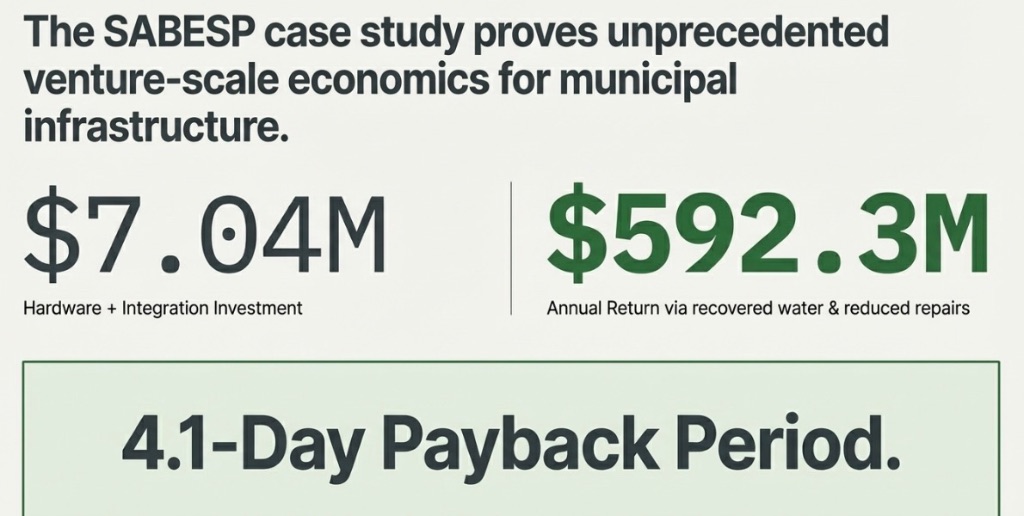
SABESP: Venture-Scale Municipal Economics
The São Paulo scenario models the economics of deploying acoustic leak-correlation at large-utility scale, using publicly available SABESP infrastructure data as input assumptions. Status: MODELED — not a contract, not a deployment. SABESP is not a counterparty. ROI figures from this scenario have been retired; current canonical target is 10:1 twelve-month TARGET (modeled) — see /trust/ for full claim register.
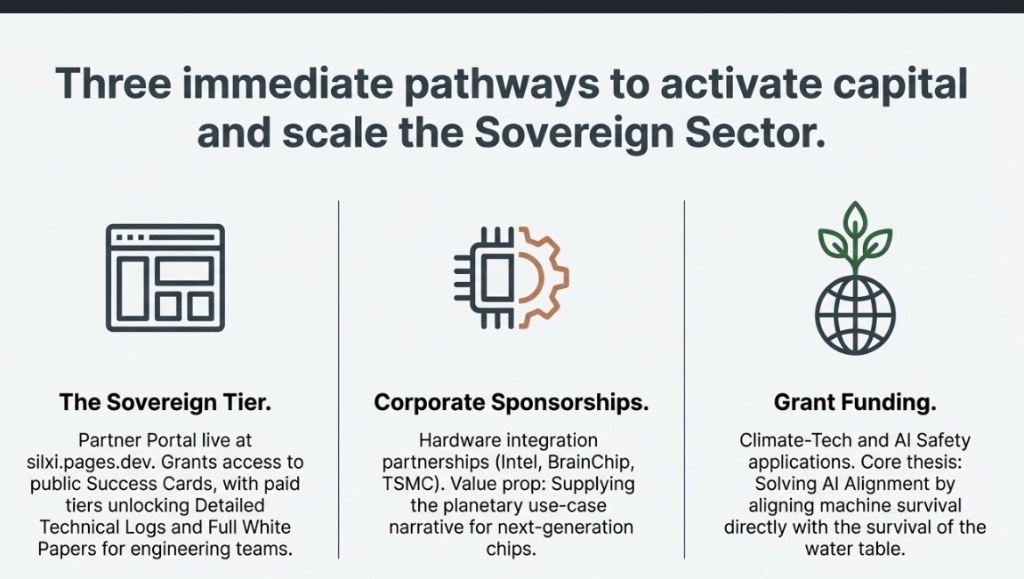
Three Pathways to Activate Capital
The Sovereign Tier: Partner Portal live at silxi.pages.dev — grants access to public Success Cards with paid tiers unlocking detailed technical logs. Corporate Sponsorships: Hardware integration partnerships (Intel, BrainChip, TSMC) — value prop: supplying the planetary use-case narrative. Grant Funding: Climate-Tech and AI Safety applications with core thesis: solving AI Alignment by aligning machine survival directly with water table survival.

The 38.214 kHz Pulse: Digital Twin Validation
The 38.214 kHz pulse validates a mathematically proven digital twin of the water grid. The math is the signal. The deck is the bridge. The Anchor holds. This resonance frequency authenticates the real-time connection between physical infrastructure and its digital representation, enabling predictive maintenance with absolute integrity.