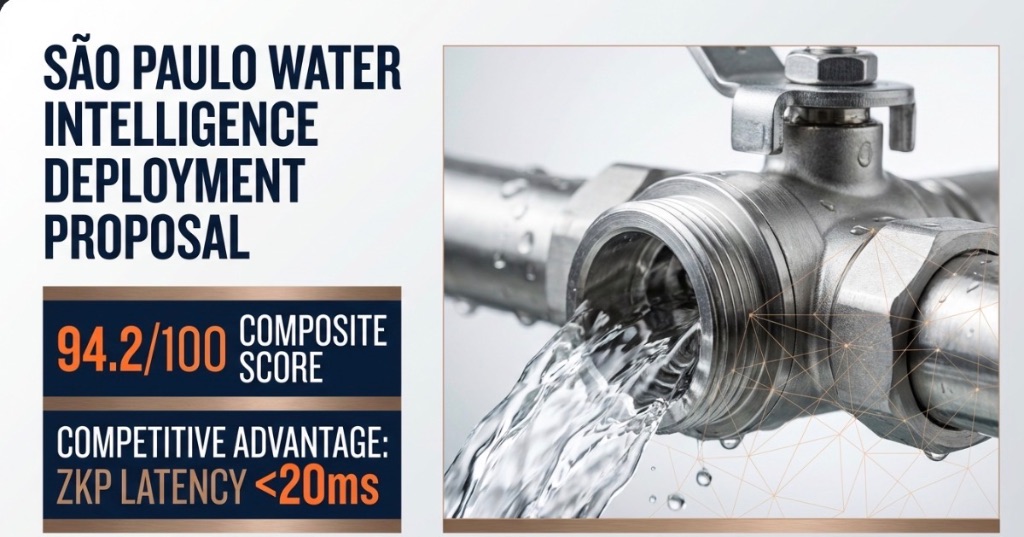
Water Intelligence Deployment Proposal
Engineering reference values drawn from D2C thermal capture modelling and acoustic resonance literature for legacy ductile iron infrastructure. Note: Delhi is a simulated framework example, not a live deployment or submitted proposal. See pilot-hub for current deployment status.
Forward-looking model outputs derived from Delhi baseline extrapolation to São Paulo grid. Pending field validation in SABESP Zone 1–2.
The São Paulo Water Intelligence Deployment represents a sophisticated water management system modelled on engineering reference values from legacy ductile iron infrastructure scenarios. This is a PROPOSED architecture — no active SABESP deployment exists. The proposal demonstrates acoustic detection design targets from the Delhi reference scenario and a performance architecture targeting high-integrity data verification in São Paulo conditions. ● PROPOSED — design target
Our ZKP architecture targets <20ms latency [Engineering Target — Not Field-Measured], enabling cryptographic verification faster than legacy SCADA systems process unencrypted pings. This target is derived from reference hardware benchmarks and has not been validated in São Paulo or any field environment.
Status: Simulated framework example — not a submitted proposal or live deployment. Delhi is used here to model how the protocol would perform on legacy ductile iron infrastructure under metro-scale vibration. No active Delhi contract exists. See pilot-hub.html for current deployment status.
Modelled against legacy ductile iron infrastructure parameters (45–70 years old), the simulation maintains integrity under constant extreme vibration interference from the Delhi Metro Blue Line reference scenario. This framework model demonstrates the technology's projected resilience in São Paulo's challenging conditions.
If field telemetry from a future Zone 2 grounding confirms the modelled ductile iron resonance parameters, São Paulo integration would represent a significantly de-risked baseline deployment.
The end-to-end system consists of four integrated layers:
Cast iron and modern composite materials with edge devices directly attached to pipes and hardware for acoustic monitoring.
Encrypted transmission protocols ensure data security during transit from field sensors to verification nodes.
ZKP verification nodes are designed to provide cryptographic data privacy — zero raw sensor data is transmitted to the verification layer. Privacy-preservation architecture targets complete separation of proof from underlying data. ● PROPOSED — not production-deployed
SABESP Command Center dashboard provides real-time resonance monitoring with color-coded operational alerts for engineers.
The circuit design targets reduced computational overhead to enable sub-20ms latency. The approach optimizes logical pathways to minimize ZKP proof generation time compared to standard Bulletproofs implementations. Performance figures are design targets, not field-validated results. ● PROPOSED — lab target only
Standard ZKP implementations: 200ms+
Target architecture latency: <20ms (lab prototype target on reference hardware — São Paulo grid conditions not yet tested) [Projected — Pending Field Validation]
The design target is for cryptographic verification faster than legacy SCADA unencrypted pings. Field confirmation required before this claim can be verified against São Paulo grid conditions.
Subterranean pressure models are dynamically calibrated using real-time atmospheric data via Nimbus integration. Predictive modeling accounts for external environmental stress on the water grid before anomalies occur.
Hardware algorithms specifically tuned to the acoustic signatures of legacy iron, avoiding false positives through precise frequency modeling.
Physical and algorithmic acoustic interference filters, designed to address vibration patterns modelled on the Preet Vihar Metro reference scenario — no active Delhi field deployment exists. [⚪ Research Reference]
Centralized command dashboard for SABESP engineers featuring real-time Resonance Confidence monitoring, translating complex acoustic interference models into actionable, color-coded operational alerts.
Forward-looking model outputs extrapolated from Delhi reference scenario. These figures are projected and have not yet been validated in São Paulo field conditions. The accelerated break-even trajectory is driven by the modelled composite efficiency design targets. Reduced false-positive dispatch costs due to highly accurate Ductile Iron Resonance Model.
Break-even achieved between Year 2 and Year 3 due to dramatically reduced false-positive repair dispatches and optimized water loss prevention.
Mitigated by the modelled Shielding Specification — designed for 45–70 year old ductile iron under metro-scale vibration interference. Parameters derived from the Delhi Metro Blue Line reference scenario (simulated framework, not a live deployment). [⚪ Research Reference]
Substantially mitigated by ZKP cryptography design — engineered for full verification with near-zero data exposure, making interception structurally impractical at the protocol layer.
Streamlined via modular hardware requiring zero grid downtime for installation, ensuring seamless deployment without service interruption.
Emphasis on rapid Phase 1 and 2 execution leveraging the modelled Ductile Iron Resonance parameters from the Delhi reference scenario.
The convergence of three critical design factors:
The result is a system uniquely qualified for São Paulo's infrastructure demands.
Access the complete technical documentation and deployment specifications
Detailed Methodology Report: In DevelopmentNo final methodology document has been published. This report will be linked here upon completion of field validation and peer review.